You’ve Reached The Current Usage Cap For GPT-4 | How to Fix
Since the groundbreaking launch of ChatGPT, generative AI (Artificial Intelligence) has been at the center of attention for all of us. The chatbot uses vast amounts of scraped data to generate responses to human input that are accurate most of the time. Previously based on GPT-3.5, it has now been upgraded to GPT-4 and is accessible through ChatGPT Plus. The subscription service is priced at $20 per month which is fairly cheap for what it has to offer.
Available for ChatGPT Plus subscribers since March 14, 2023, GPT-4 has so many under-the-hood changes. However, it’s not without its drawbacks. The two most noticeable drawbacks are, slower speed compared to GPT-3.5 and limitations on usage, including message caps and token limits over several hours. So you might have experienced You’ve reached the current usage cap for GPT-4, please try again after X (Time).
So, if you too have encountered the message that, you’ve reached the current usage cap for GPT-4, you’re not alone. Read on to learn in-depth what it implies and if there are any fixes.

What does “You’ve Reached The Current Usage Cap For GPT-4” Mean
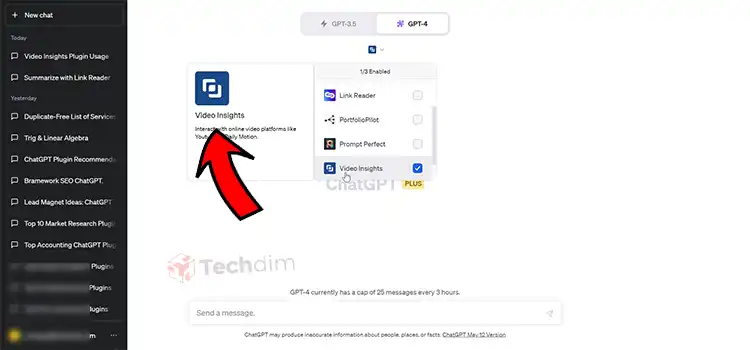
When you log into your ChatGPT Plus account and select GPT-4, you’ll see the following notice above the query box.

“GPT-4 currently has a cap of 40 messages every 3 hours. Expect significantly lower caps, as we adjust for demand.” ( Updated information on 15/12/2013.
However, if you have been using GPT-4 for a while, you already know that it’s significantly lower than what it used to be. Previously it was 25 messages every 3 hours and before that it was 100 messages every 4 hours.
So, this error means that you have reached the messages or prompts limit and you will not be able to continue the conversation with the GPT-4 model. That means you have reached 40 conversations within 3 hours. You have to wait until your time limit is over. But don’t worry you can continue its free version to the GPT-3.5 model.
Now it’s obvious that OpenAI has implemented this to manage the increasing demand for the technology. And while it certainly is frustrating, some people speculate that it can get more restrictive in the coming days.
How Does the Usage Cap for GPT-4 Work?
Since OpenAI hasn’t provided much explanation, it’s normal to get confused about how the message cap actually works.

So, here’s how the usage cap works for GPT-4:
- Upon sending your initial message, a 3-hour timer starts which is determined by OpenAI.
- Within this time window, you are allowed to send up to 50 messages (which may increase or decrease in the future).
- Once the 3-hour timer expires, your message limit refreshes, allowing you to send another 50 messages.
How to fix the GPT-4 usage cap
Honestly, there are no specific steps to fix this issue. But to address the issue, premium users have the option to switch to the “default model,” which is GPT-3.5. This adjustment, however, results in a temporary loss of premium server bandwidth access. Consequently, these users will experience the same level of AI text generation capabilities as the general user base. Given that OpenAI CEO Sam Altman has reported over “100 million weekly active users” at OpenAI DevDay, this access is notably restricted due to the high volume of users.
What to Do If You’ve Reached the Current Usage Cap?
Sadly, there aren’t any easy workaround for this. The message cap is here to stay for quite a while, as it seems. But here are some things you can do as an alternative.
1. Get API (Application Programming Interface) Access
For those familiar with coding, API access to GPT-4 is available. With API access, you have the freedom to utilize GPT-4 without limitations, paying on a per-use basis. However, obtaining API access may be challenging for individuals who are not developers or company CEOs.
2. Purchase a Second Account
Another workaround to this is to purchase a second plus membership. You can purchase it for your friends or family as well. This way, you can extend your message limit and continue to work without restrictions.
3. Broaden Your Interactions to Lessen Conversations
To make the most of each interaction, try maximizing the number of tokens per prompt and response in ChatGPT (GPT-4). Remember that there is a token limit of approximately 4,096 per prompt/response combination. OpenAI’s tokenizer tool can help you track and optimize token usage if needed.
4. Switch to GPT-3.5
Consider switching to GPT-3.5 when you have reached the usage limit of GPT-4. While GPT-4 is superior, GPT-3.5 remains still valuable, especially for its rapid responses. Utilize GPT-3.5 as an alternative when you’ve maxed out your GPT-4 usage cap.
Should You Feel Cheated?
If you feel like you’ve been cheated with the introduction of a usage cap in GPT-4, you are not alone. So many users have responded negatively about this. But they’ve mentioned that in their GPT-4 press release.
“ChatGPT Plus subscribers will get GPT-4 access on chat.openai.com with a usage cap.”
They have also mentioned that they’ll scale up and optimize in the upcoming months. According to OpenAI, they may also introduce new subscription plans for higher-volume GPT-4 users.
But what about free users? Well, they hope to let free users try it out too, offering some amount of free GPT-4 queries to them.
FAQs (Frequently Asked Questions and Answers)
How to access GPT-4 for free?
Microsoft integrated ChatGPT’s capabilities into its tools and services. As a result, Bing Search became the first platform to incorporate GPT-4, offering users a convenient and free way to experience its power.
What are the limitations of GPT-4?
GPT-4, like 3.5, has a constraint related to its training data. It lacks awareness of events that occurred after September 2021. So, GPT-4 might not offer precise output for inquiries requiring up-to-date information.
What’s the operational cost of ChatGPT?
According to research firm SemiAnalysis, OpenAI is estimated to spend up to $700,000 per day to maintain its infrastructure.
End Notes
According to an estimate, ChatGPT receives more than 10 million queries per day. To keep up with the queries and to prevent over-exhaustion due to huge demand, it’s normal that they’ll implement a usage cap. If you can’t wait it out, we recommend using multiple plus subscription plans.
Thanks for reading. Comments here if you have any further queries.
Subscribe to our newsletter
& plug into
the world of technology